Comment “LAUNCH” to get this n8n workflow that replaces your $200k sales team.
You’ve seen tons of posts like this on LinkedIn:
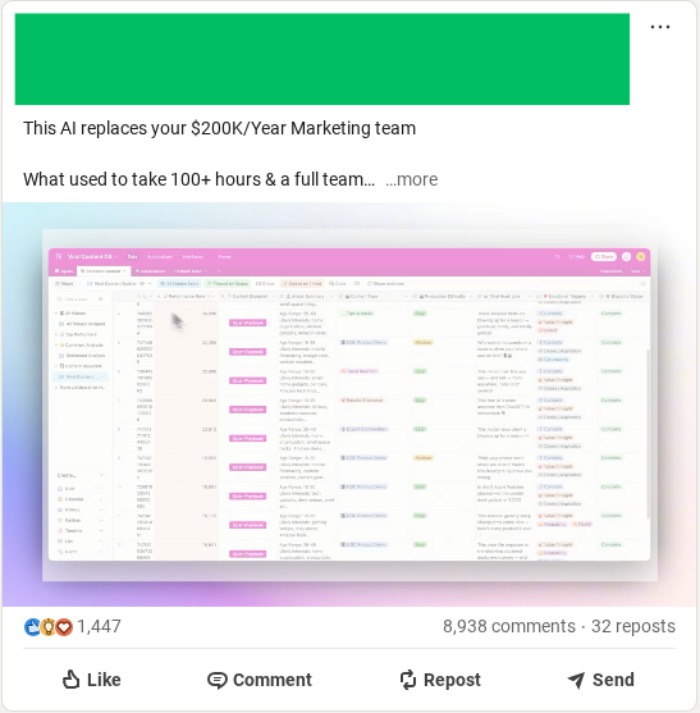
Every week, a new workflow, a new agent, or a new automation system appears with the promise that it can replace your entire sales team. The pitch is simple: comment a word, get a workflow, and remove the need for salaries, training, or management.
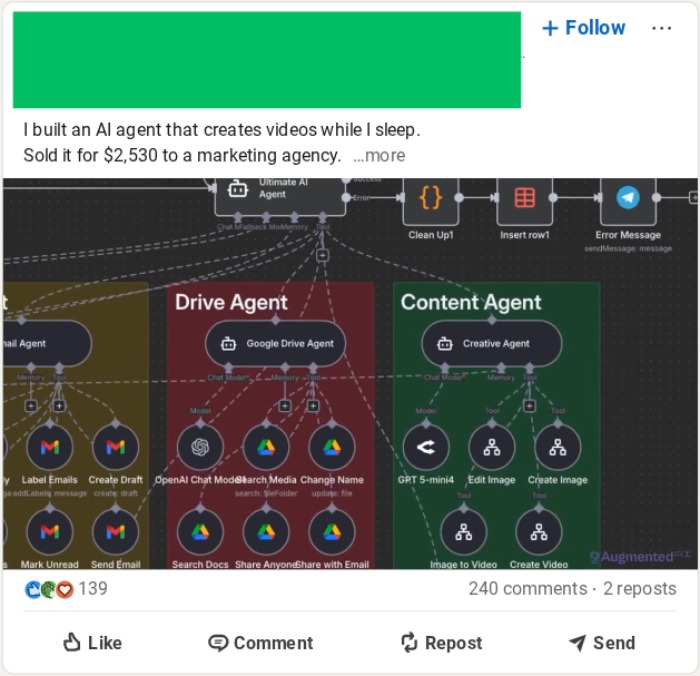
The appeal is obvious. In a difficult economic environment, any system that promises predictable output without human dependency looks alluring. Founders and CXOs engage because the proposition feels like relief.
But once you look closely, the illusion collapses. The workflows are rarely usable without heavy modification. They lack context, they lack nuance, and they assume a level of generality that does not exist in real sales operations. Hence, they break the moment they hit a real-world production environment. This is because the “agencies” that build them rarely understand the nuances of your business.
What remains after the hype fades is an important question:
What exactly can AI and automation do in sales and marketing; and what remains fundamentally human?
Building up on the learnings from the first chapter on the impact of AI and automation, this chapter answers this question in a structured, grounded way.
the hype
The hype is built on a simple misunderstanding.
It assumes sales is a linear, mechanical activity that can be fully captured in a diagram.
In reality, sales is a fluid mix of judgment, edge-case handling, activity sequencing, timing, prioritisation, intuition, pattern-recognition, and human interpretation of context. None of these qualities are programmable in a generalised workflow. The moment an automation system tries to replace an entire sales function, it collapses under real-world variation.
An AI system that tries to do everything ends up doing nothing well. The initial boost in results is due to the sheer volume and rate of outreach. They say that only 3% of your TAM is in a buying phase and AI-powered outbound helps you reach this segment by blasting a 100% of your TAM in a few months. Hence, unless your KPI isn’t “booked meetings”, you will hit the wall.
The mistake is not the ambition. The mistake is the scope.
Most new-age agencies promise 15-30 booked meetings. That’s the metric for the 3% of your TAM which you will harvest quickly if everything goes well. But what about the 97%? That’s your actual pipeline but by the time you hit the wall, your organization is hooked on cashflow, the results and the leadership cannot think beyond ROI.
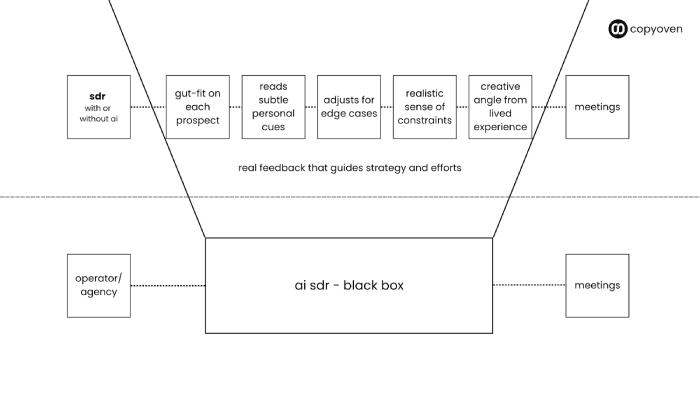
What cannot be measured in dollars, will not get prioritized and in the long term, your sales will collapse because the real feedback and learning is replaced by metrics that don’t show the full, 100% picture.
the real division of labor
The correct way to think about AI (or agentic AI for that matter) and automation is to separate them into two categories instead of mixing them into one catch-all idea:
1. automation: the engine of discipline
Automation exists to perform actions that do not require interpretation. These are tasks where the logic stays constant.
Examples:
- Moving a lead from one system to
- Scheduling posts across multiple Updating statuses or fields
- Triggering confirmations or reminders
- Recording data in sheets or CRMs
These tasks suffer when humans handle them. They are repetitive. They demand perfection. They demand consistency that people cannot maintain every day of the year.
A good automation workflow is not complex. It does not need to look impressive. It does not require fifty connected nodes. In real operations, effective automation is usually small, scoped, and built around a narrow process.
Its purpose is simple: maintain discipline in the system.
It does not create strategy. It does not evaluate. It does not replace judgment. It removes mechanical labor so humans can focus on meaningful work.
2. agentic ai: the tool for micro-judgment
Agentic AI is different.
It can interpret.
It can summarise.
It can transform.
It can make small decisions inside a tightly controlled boundary.
Examples:
- Answering questions using your documentation
- Summarising long pages or transcripts
- Generating message variations
- Extracting insights from text
- Rewriting content into different tones or structures
This is not autonomy or replacement. It is augmentation.
The moment you widen the scope and ask an agent to “judge a market,” “qualify a segment,” or “evaluate a list,” the quality collapses. It produces confident statements without the grounding of your experience.
The correct use of agentic AI is to divide your own thinking into steps and assign a small step to the AI. You remain the decision-maker. The AI remains the helper.
This is the real and sustainable division of labor.
What becomes possible when you stop trying to replace teams
When you stop imagining AI as a substitute for people, you begin to see its actual potential:
AI and automation lift the baseline of what a team can produce.
Automation frees teams from repetitive tasks. AI accelerates ideation, drafting, transformation, and research.
Together, they allow humans to work on what was previously impossible under normal time constraints.
Your team can now spend more time on:
- Market interpretation
- Designing better messaging
- Deep research
- Better content
- Creative judgment
- Customer understanding
- Strategy and reasoning
- Higher quality execution
- Consistent brand voice
- Long-form thinking
- Asset quality that used to require specialists
This is not a replacement but an expansion of capability.
What your sales and marketing team should actually do with automation
Automation should own the mechanical pipeline. It includes all:
- Status changes
- CRM updates
- File and sheet syncing
- Scheduling
- Reminders
- Templated repetitive processes
- Low-judgment transfers across systems
This gives your team operational reliability.
- No dropped tasks.
- No missed steps.
- No bottlenecks caused by human forgetfulness.
Automation builds the foundation on which good work stands.
What your sales and marketing team should actually do with ai
AI should own:
- First drafts of content
- Summaries of long material
- Extraction of insights
- Writing transformations
- Rewriting for clarity
- Generating variations
- Visual and design assistance
- Initial ideation
- Compiling references
- Structuring raw material into formats
- Filling specific skill gaps
This gives your team creative and analytical leverage. The baseline output becomes faster, richer, and more consistent.
But human judgment remains the filter for quality.
What only humans will continue to do in sales and marketing
There are areas where AI currently cannot, and may never, substitute human capability:
- Taste
- Contextual judgment
- Coherence and intuition across tasks
- Ethical and strategic reasoning
- Interpretation of nuance
- Understanding what customers truly want
- Setting direction
- Making tradeoffs
- Evaluating the value of an idea
- Integrating insights into a project
- Deciding what matters and what does not
These are not optional qualities in sales and marketing. They are the essence of it.
Firing teams because AI exists means removing the very capability that becomes the bottleneck when generation becomes cheap.
A real example of how this works
Here is my workflow when I have to write an article on a new topic:
I collect transcripts from YouTube videos I like on the topic. I use Perplexity in deep research mode with only the social sources enabled when I want to understand public sentiment. It pulls Reddit discussions and gives me real user viewpoints. Next, I drop both of them into NotebookLM and create AI podcasts to view the data from different POVs.
Next, I put all of them in Gemini, ChatGPT and Claude to make temporary consultants that compare arguments, extracts themes, and highlights differences in perspective. Then I use these chatbots to rewrite, refine, and reshape my writing.
I use Nano Banana from Google to create banner images for my articles. It fills a design gap, removes the need to find stock photos, and lets me maintain a visual standard without needing a designer.
It is noteworthy that I still choose a majority of the sources myself. I still judge every output. I still inject my own principles. I remove weak points, add my own thoughts, and decide what is worth including. Once the final article is ready, I will create a distribution plan that does justice to this article.
Yes, there are platform-specific SOPs in place but I cannot have a single checklist/workflow to distribute all articles. As professionals, we need to look at every asset with sincerity and do justice to it. You cannot do justice to work by hiding behind a checklist. That would be dishonesty because the output will be a count of activities and not impact.
The result is a level of content depth and amplification that would previously take a week of steady effort. Now it takes five to six hours of focused work.
Not because AI replaced expertise. But because AI amplifies existing expertise.
This is the real transformation.
The actual promise of ai and automation in sales and marketing
AI and automation are not tools for shrinking teams. They are tools for shifting teams into more valuable work.
They do not remove the need for humans. They elevate the contribution of humans.
AI and automation:
- Compress cycles.
- Raise quality.
- Increase the surface area of what one person can think about in a day.
The future is a world where the same teams produce work that used to require far larger organisations.
- Use automation to create discipline.
- Use AI to create leverage.
- Use humans to create meaning.
And use all three together not to make the normal nominal, but to make the performative phenomenal.